

DIASHIELD®
The Robust Coating for Decorative Surfaces
DIASHIELD® coatings for achieving functional and decorative properties in various areas of application
- The cost-effective alternative for wear and corrosion protection
- High decorative value through glossy layers
- Functions as a diffusion barrier and running-in layer
- Anti-adhesive effect and wear protection for mold making
Applications
Optimal Wear Protection
Depending on the composition of the electrolyte system, electrolytic and chemical nickel produce a surface gloss that can be controlled within certain limits. A glossy surface is achieved with layer thicknesses in the range of a few micrometers (</= 2-10 μm) thick.
In combination with a layer for increasing wear resistance or modifying sliding behavior, such as DIAGLIDE® or DIAGRIP®, a DIASHIELD® coating produces an improved appearance or an additional decorative look. This can be advantageous in numerous applications, since functional surfaces can have varying degrees of roughness. A decorative appearance can increase end-user acceptance of a functional coating.
The hardness of the layer, when using chemical nickel, can be adjusted to values between approximately 550 HV and 1,100 HV, depending on the phosphorus content and post-treatment. This allows, for example, hardness or wear requirements of a combination layer (e.g. made of DIAGLIDE® and DIASHIELD®) to be met.
DIASHIELD® coatings can also be used as dispersion layers with hBN/PTFE incorporation as release agents, anti-stick coatings in mold making and injection mold making. When used in combination with DIAGLIDE® and DIAPROTECT® layers, wear and adhesion properties can be optimized together.
In the case of electrolytic nickel, no dimensional deviations due to edge build-up occur, thanks to the typical layer thicknesses of the DIASHIELD® system of less than 5 μm.

At a Glance
Type
Coating made of electrolytic or chemical nickel and nickel-phosphorus
Properties
- Wear-resistant friction pairing of metallic components
- Adjustable hardness of the nickel-phosphorus layer (approx. 550 HV0.1 to approx. 1,100 HV0.1)
- High corrosion resistance for both nickel and nickel-phosphorus
- Good contour accuracy and very uniform layer thickness with chemical nickel
- High layer thicknesses when using electrolytic nickel
Application
Sliding pairings in extremely demanding systems with high friction and corrosion loads, such as injection molds, textile machinery components.
Coating Characteristics
Nickel-phosphorus layer from approx. 5 μm to approx. 22 μm with and without dispersion substances (hBN, PTFE)
Nanodispersions (< 1 μm), dispersions (
Substrate Characteristics
Base material suitable for electrolytic coating, with adapted, defined roughness
Example Solutions
DIASHIELD in Use
There Is Always a Perfect Solution
The requirements are different for every surface. Our coating process is flexible and has an adjustable degree of hardness. We adapt to your needs. Talk to us.
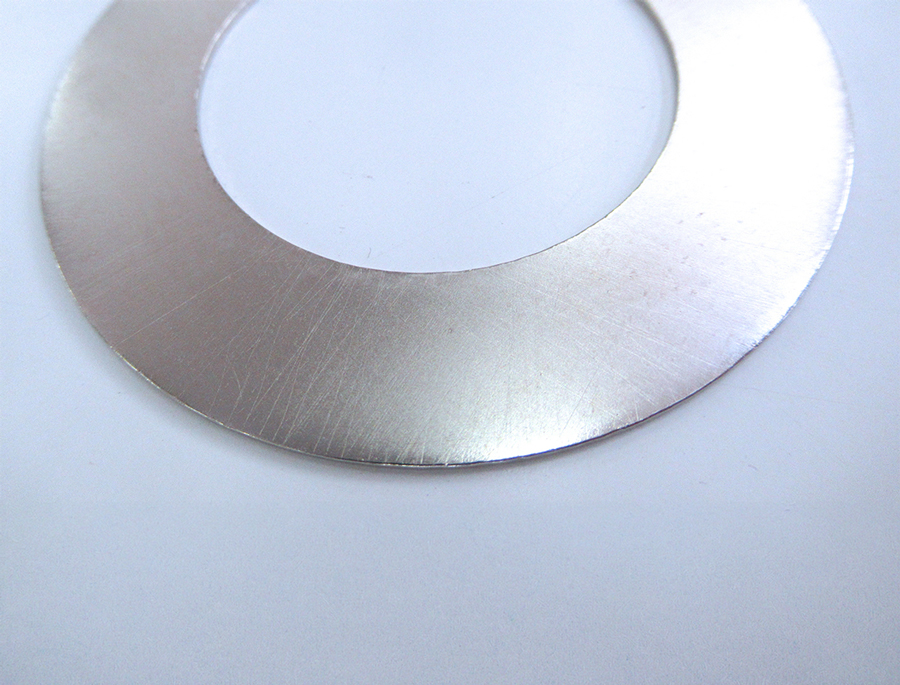
DIASHIELD® coatings meet the highest standards for decorative applications.
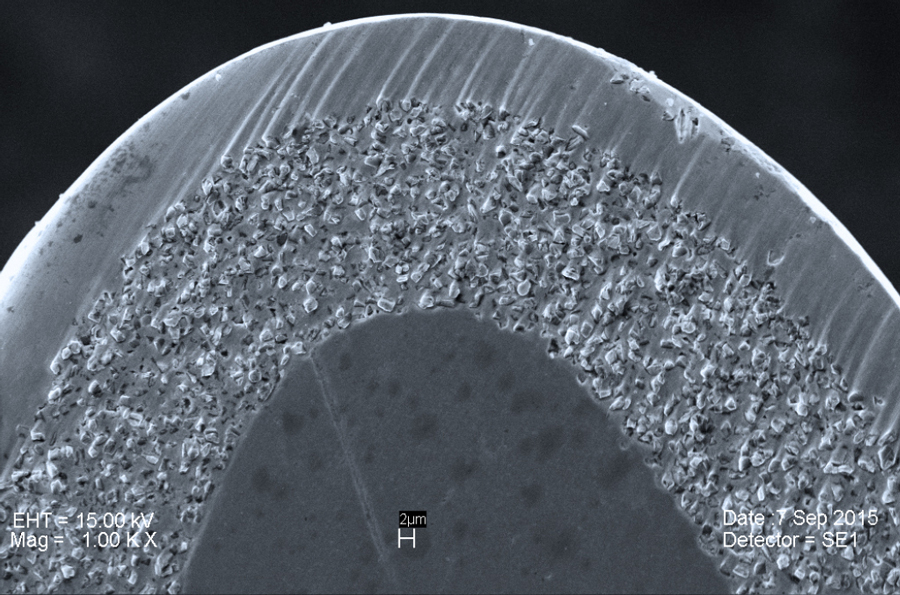
DIASHIELD® provides the glossy finish and is the perfect running-in layer and diffusion layer.
Advantages
Advantages of DIASHIELD
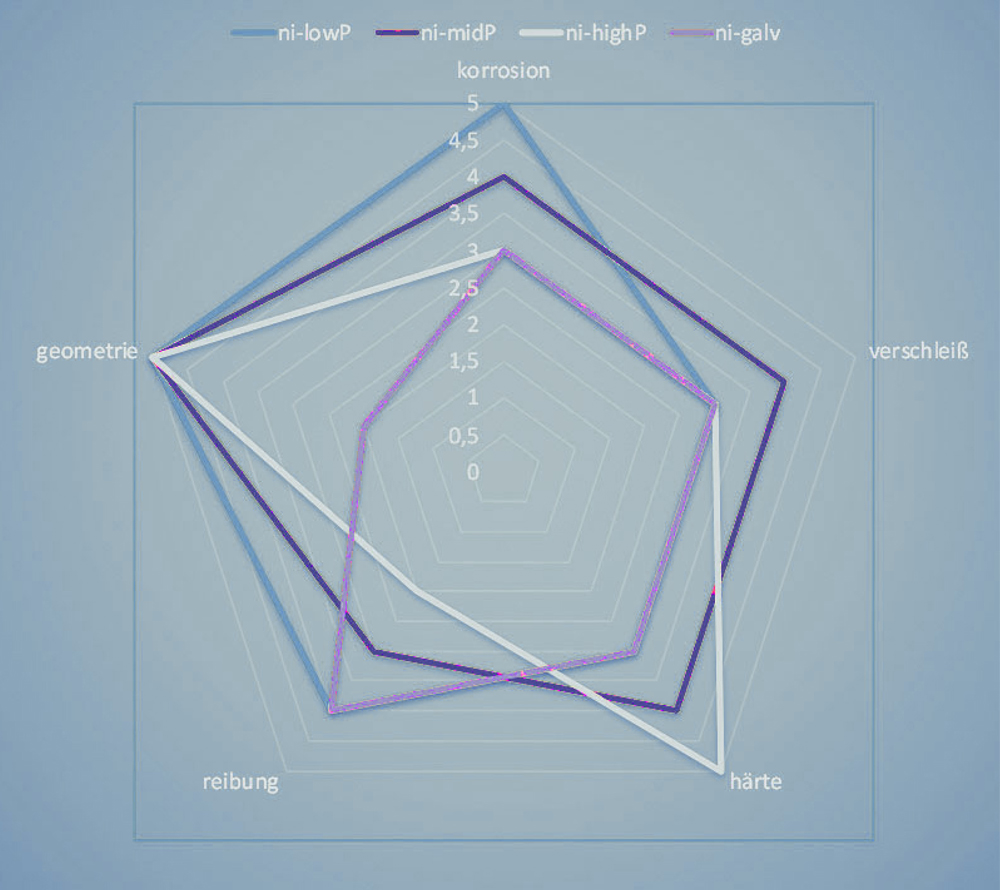
The layers based on nickel and nickel-phosphorus are characterized by the fact that they possess several important properties, and that these properties can be adapted to the requirements of the application depending on composition and/or heat treatment. This can be illustrated using a radar chart for qualitative assessment, based on which the user can select the properties needed.
Advantages at a Glance:
- The cost-effective alternative for wear and corrosion protection
- High decorative value through glossy layers
- Functions as a diffusion barrier and running-in layer
- Anti-adhesive effect and wear protection for mold making
- Effective combination of the important properties
- Wear protection and corrosion protection for metal surfaces
- Improvement of the running-in behavior of DIAPROTECT® or DIAGRIP® layers
- Use without the need for structural modifications
- Insensitive to lubricants
Requirements
Requirements for Wear and Corrosion Protection Through Dispersion Layers
The property of wear and corrosion protection is tied to certain structural requirements, or certain structural designs influence the properties of the protective layers:
01
Design of the Contact Surfaces
Wear caused by the friction of surfaces against each other is strongly influenced by the type and size of the actual (microscopic) contact areas. The roughness of the contact surfaces, as well as the orientation of machining structures such as turning or grinding marks, play a role here. The smoother a surface is, the larger the actual contact areas and the lower the actual surface pressure at the contact areas. The degree of wear tends to increase as the surface roughness of one or both friction partners increases.
02
Design of the Contact Surfaces
The efficiency of force and torque transmission depends on the actual (microscopic) contact surfaces. The roughness of the contact surfaces, as well as the orientation of machining structures such as turning or grinding marks, play a role here.
03
Hardness of the Contact Surfaces
A higher surface hardness improves resistance to shearing or chipping of material from the component surfaces of the friction partners. The risk of shearing or chipping is lower when the surfaces of the friction partners consist of the same material.
04
Mechanical Property of the Substrate
Layers with high hardness, such as chromium, require a base material with sufficiently high load-bearing capacity to prevent cracking or breaking of the layer; alloy steels, for example, offer good suitability.
05
Coverage of the Contact Surfaces with Foreign Substances
The friction properties of two tribological surfaces are altered by the presence of foreign substances (oil, grease, dirt). Oil and grease generally have a positive effect on friction properties, while contamination has a negative effect. However, oils and greases, as well as any degradation products that may form, can worsen corrosion resistance. When using dispersion layers, it must be checked to what extent foreign substances impair the effectiveness of the embedded particles.
06
Design
Chemical nickel layers (primarily nickel) are characterized by high contour accuracy and require no mechanical post-processing to achieve surfaces with high fit precision. With electrolytic coatings, edge build-up must be expected, which becomes more pronounced as layer thickness increases. In individual cases, the options for mechanical post-processing prior to applying a coating should be reviewed.
Characteristics
For DIASHIELD Coatings
The layers for improving appearance as well as running-in behavior can be combined with pre-coatings such as DIAGLIDE® or DIAPROTECT® in different compositions, different deposition methods, as well as in combination with dispersion layers using different types of dispersion substances. The chosen layer combination depends on the load in use and can consist of both wear load and corrosion load. Due to the layer thicknesses of only a few micrometers (e.g. < 5 μm), the DIASHIELD® system causes no changes to component geometry and only minimal changes to properties such as wear behavior.
Contact
Your Inquiry
Do you have questions about our product systems or fields of application? We would be happy to advise you comprehensively via our contact form.