

DIAFIN®
The Smart Coating for Machining and Finishing
DIAFIN® coatings for improving the service life of tools in mechanical processing and finishing
- The optimal solution for tools
- Suitable for machining and finishing
- Thin-film system (< 20 μm)
- Long service life and regenerable
Applications
Improving Tool Properties
Tools for the mechanical processing of metallic and non-metallic substrates must exhibit good resistance to friction and wear, combined with a certain level of corrosion resistance against various environmental influences. Nickel and nickel alloys meet these challenges to a high degree.
The DIAFIN® coating system is the solution for creating surfaces on tools for machining and finishing materials. Depending on the surface requirements, the DIAFIN® coating is based on a chemically or electrolytically deposited nickel-phosphorus alloy, or electrolytic nickel.
The hardness, and especially the friction and wear properties, can be adjusted over a wide range for the respective task through the incorporation of dispersion substances or heat treatment.
The hardness of a DIAFIN® layer, when using chemical nickel-phosphorus, can be adjusted to values between approximately 550 HV and 1,100 HV, depending on the phosphorus content and post-treatment. For DIAFIN® dispersion layers, cubic boron nitride (cBN) or diamond are mainly used as embedded particles. The layers are deposited in thicknesses of approximately 10 μm up to several hundred micrometers. In addition to good mechanical durability, the layers are also characterized by very high resistance to corrosion.
Typical Applications for DIAFIN® Coatings Include:
- Dressing tools for thread or fit gauges, limit plug gauges
- Drills, reaming, or honing tools
- Tools for grinding, finishing, and superfinishing
- Belts for grinding or honing.
DIAFIN® coatings are suitable for further conditioning. For example, applying an additional DIASHIELD® layer with a thickness between 3 μm and 20 μm reduces surface roughness and optimizes running-in behavior.

At a Glance
Type
Dispersion layer based on nickel and nickel-phosphorus
Properties
- Wear-resistant coating for machining and finishing
- Adjustable hardness of the nickel-phosphorus layer (approx. 550 HV0.1 to approx. 1,100 HV0.1)
- High corrosion resistance
- Perfect contour accuracy and very uniform thickness with chemical nickel
- High layer thicknesses when using electrolytic nickel
Application
For coating machining tools
Coating Characteristics
Nickel-phosphorus layer from approx. 5 μm to approx. 22 μm with dispersion substances
Particle sizes from 2 μm to 500 μm
Substrate Characteristics
The substrate material must be suitable for electrolytic coating in order to achieve very good adhesion of the coating to the substrate.
Example Solutions
DIAFIN in Use
There Is Always a Perfect Solution
The requirements are different for every surface. Our coating process is flexible and has an adjustable degree of hardness. We adapt to your needs. Talk to us.
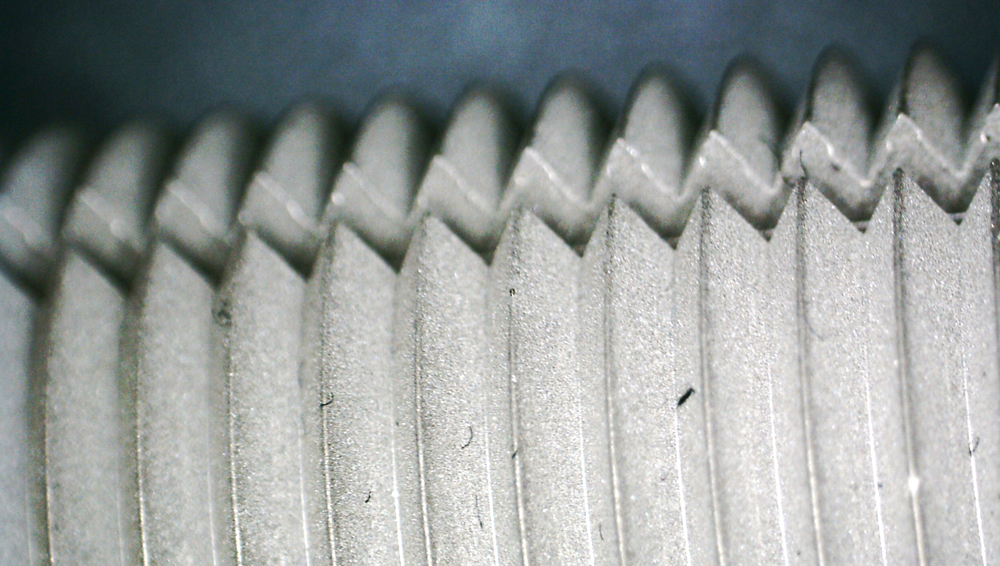
DIAFIN® coatings based on diamond and CBN particles are suitable for use in cutting tools.
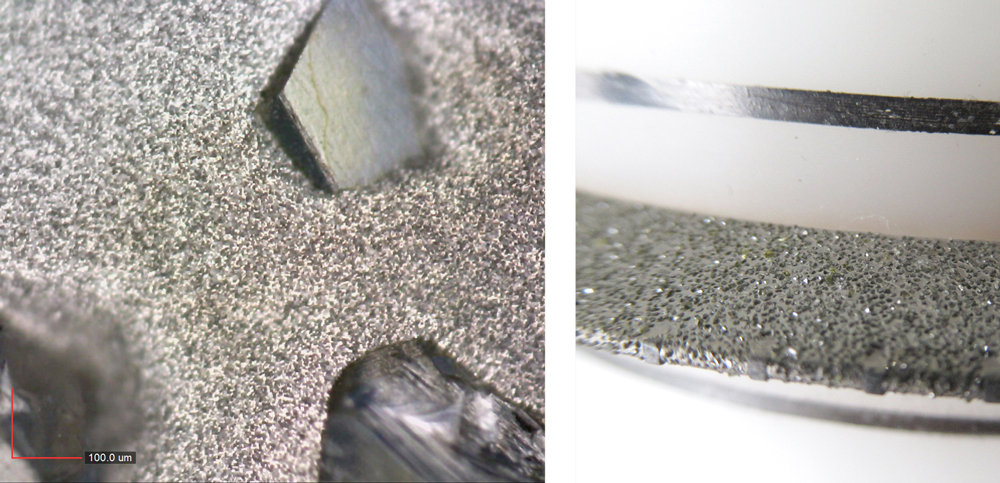
Particle sizes from 2 to 500 μm for use from finishing to machining. Machining tools with Diafin coating. Large grain sizes (200-500 μm) combined with small grain sizes (2-15 μm).
Advantages
Advantages of DIAFIN
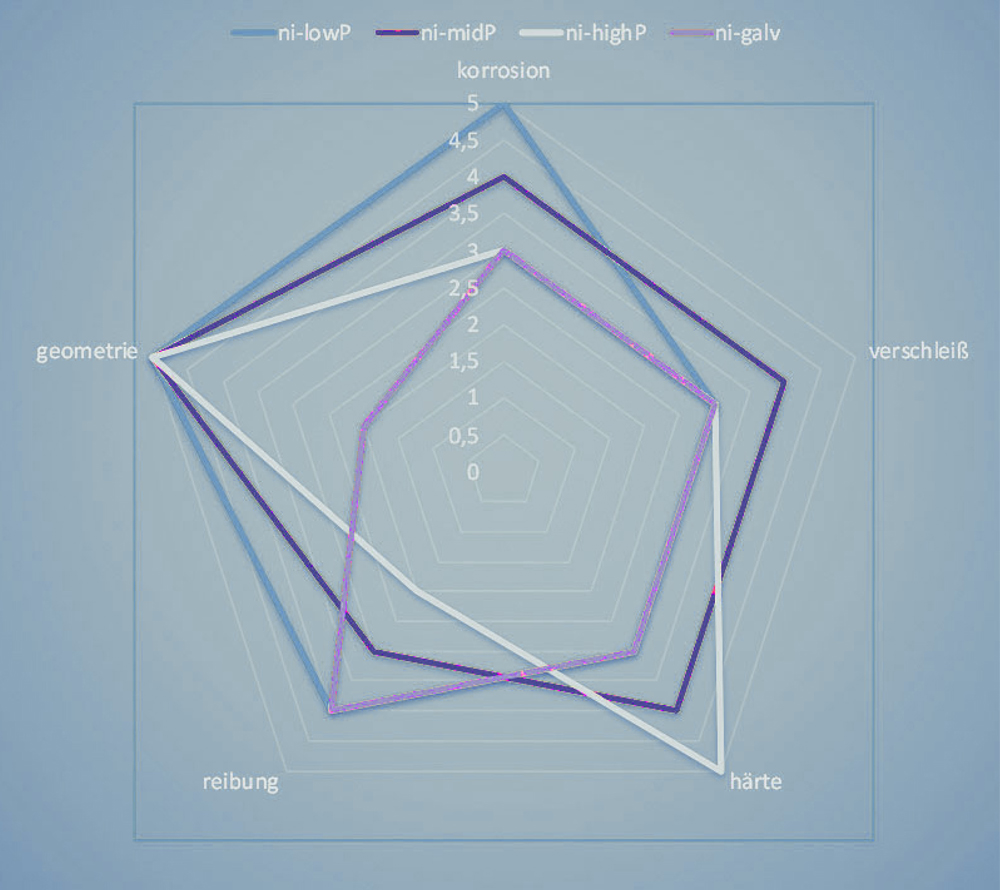
The DIAFIN® dispersion layers based on nickel and nickel-phosphorus are characterized by the fact that they possess several important properties, and that these properties can be adapted to the requirements of the application depending on composition and/or heat treatment. This can be illustrated using a radar chart for qualitative assessment, based on which the user can select the properties needed.
Advantages at a Glance:
- The optimal solution for tools
- Suitable for machining and finishing
- Thin-film system ( < 10 μm) + thick-film system ( < 500 μm)
- Long service life and regenerable
- Free choice of cutting performance
- Versatile applicability across almost all tool types
- Cost reduction compared to conventional tool materials
- Use without the need for structural modifications
- Easy handling
Requirements
Requirements for DIAFIN Coatings
The substrate material must be suitable for electrolytic coating in order to achieve very good adhesion of the coating to the substrate. Suitability for electrolytic coating with DIAFIN® must be clarified with the client. In addition, the substrate must have sufficient load-bearing capacity to prevent excessive deformation and the resulting high mechanical stress on the coating (in extreme cases, up to mechanical failure).
When using a DIAFIN® dispersion coating, the interlocking between the hard particles (e.g. cBN and diamond) of the coating (nickel or nickel-phosphorus) and the surface of the component is determined by the surface hardness of the substrate. A higher surface hardness can, under certain circumstances, make nucleation of the substrate surface more difficult (i.e. producing a uniform, well-adhering nickel dispersion layer). A lower surface hardness increases shearing (in the form of material wear) of the component's material, and thus the occurrence of (frictional) wear.
Characteristics
For DIAFIN Coatings
In the case of a DIAFIN® dispersion layer, the thickness of the nickel layer is selected so that the particles (e.g. cBN and diamond) are reliably and homogeneously incorporated into the layer.
The layer thicknesses required for this are listed in the table below.
A characteristic for the properties of the layer is provided by chemically deposited nickel (if used), with phosphorus contents between 1% and up to 13%, available in three states:
- Low phosphorus content – 2% to 5% / high deposition hardness / lower corrosion resistance
- Medium phosphorus content – 5% to 10% / medium deposition hardness / higher corrosion resistance
- High phosphorus content – 10% to 13% / lower deposition hardness / high corrosion resistance
The phosphorus content determines the base hardness of the nickel layer, the maximum hardness achievable through heat treatment, and the corrosion resistance.
Contact
Your Inquiry
Do you have questions about our product systems or fields of application? We would be happy to advise you comprehensively via our contact form.