
DIAGLIDE®
The Flexible Coating for Sliding Surfaces
Low friction values for heavily stressed tribological systems with DIAGLIDE®
- The all-rounder for tribological systems
- Reduces friction and wear
- Applicable to all components
- High lubricant film affinity
Applications
Sliding Surfaces
In numerous applications, it is necessary to move metallic components against one another without them being subject to noticeable wear during use. Depending on the field of application, such component or material contact can occur with or without additional lubricant.
Typical examples of components include rotors and plungers for oil extraction, drive components for internal combustion engines, transmissions or compressors, hydraulic cylinders or hydraulic components, pumps, pressure cylinders, or components in textile machinery. In most cases, the requirements go beyond high wear resistance combined with low friction, as high corrosion resistance of the surface is also particularly needed. In addition, applied DIAGLIDE® coating systems must exhibit exceptionally good adhesion to the base material and, in the case of cost-intensive components, allow for the repair of damaged or worn surfaces.
Among the widely used wear-resistant coatings are, above all, those based on chromium and nickel or nickel alloys, which are used for DIAGLIDE® coatings. Both materials have a high to very high base hardness. Hard materials withstand mechanical stresses under applied pressure and/or friction. This prevents chipping and breakage of coating fragments.
If, on the other hand, such chipping and breakage occur and get caught between moving components, they act as abrasive particles and intensify surface damage through wear.
Another way to reduce wear is the incorporation of friction-reducing solid lubricants – so-called dispersion layers. Proven solid lubricants include, for example, PTFE (polytetrafluoroethylene – Teflon), hexagonal boron nitride, as well as graphite and MoS2. As a matrix material for embedding solid lubricants, electrolytically and chemically deposited nickel as well as nickel-phosphorus alloys offer ideal conditions for producing surfaces with different properties tailored to the respective application. The hardness of the layers can be adjusted within a range of approximately 450 HV to approximately 1,100 HV. The corrosion resistance of the layers varies depending on the phosphorus content selected.

At a Glance
Type
Composite or dispersion layer based on nickel and nickel-phosphorus on metal substrate
Properties
- Wear-resistant friction pairing of metallic components
- Adjustable hardness of the nickel-phosphorus layer (approx. 550 HV0.1 to approx. 950 HV0.1)
- High corrosion resistance for both nickel and nickel-phosphorus
- Good contour accuracy and very uniform layer thickness with chemical nickel
- High layer thicknesses when using electrolytic nickel
Application
Sliding pairings in functional systems under high friction and corrosion loads, with or without thermal stress, e.g. hydraulic systems, pressure cylinders, engine and transmission components, cylinder bores
Coating Characteristics
Nickel or nickel-phosphorus layer from approx. 5 μm to approx. 800 μm with dispersion substances (SiC, B4C)
Nanodispersions (< 1 μm) up to dispersions > 100 μm
Friction value μ = <0.3, depending on post-processing (finishing)
Substrate Characteristics
Base material suitable for electrolytic coating, with adapted, defined roughness
Example Solutions
DIAGLIDE in Use
There Is Always a Perfect Solution
The requirements are different for every component. Our DIAGRIP coating process is flexible and has an adjustable degree of hardness. We adapt to your needs. Talk to us.
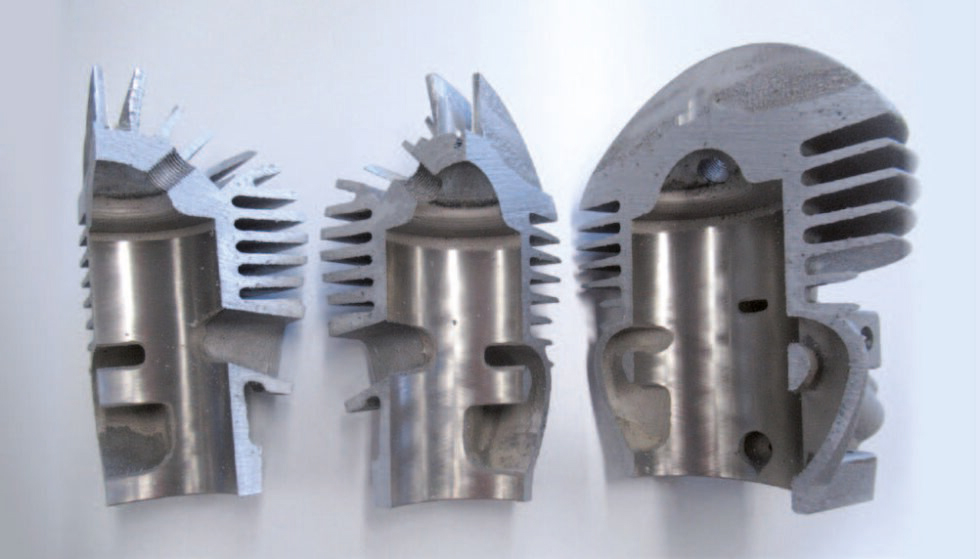
DIAGLIDE® coatings can be applied to any component with precise contour accuracy.
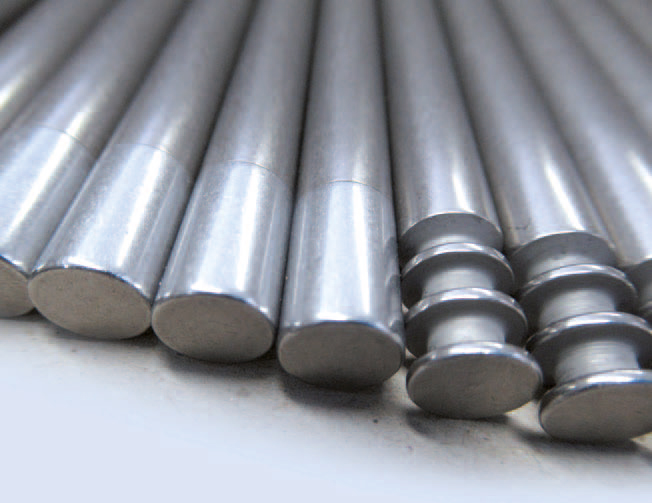
Rotor Shaft
Advantages
Advantages of DIAGLIDE
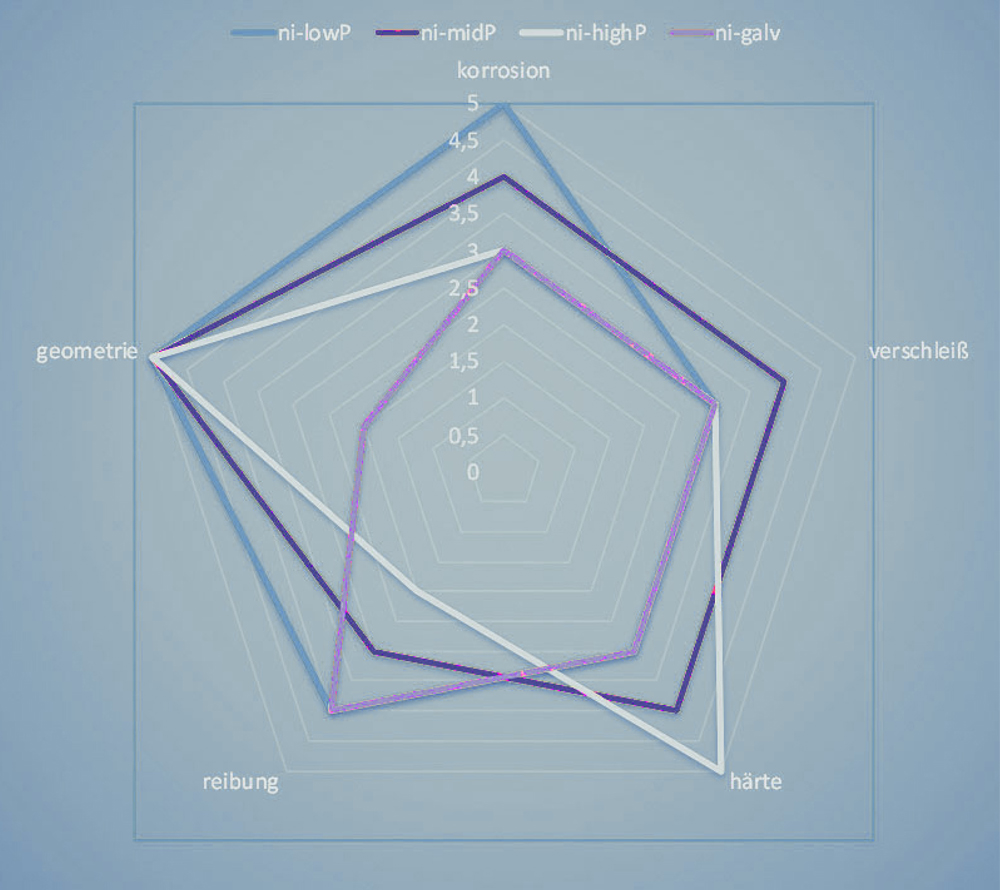
The composite and dispersion layers based on nickel, nickel-phosphorus, and chromium are characterized by the fact that they possess several important properties, and that these properties can be adapted to the requirements of the application depending on composition and/or heat treatment. This can be illustrated using a radar chart for qualitative assessment, based on which the user can select the properties needed.
Advantages at a Glance:
- The all-rounder for tribological systems
- Reduces friction and wear
- Applicable to all components
- High lubricant film affinity
- Optimal sliding behavior
- Wear-resistant friction pairing
- Long-lasting corrosion protection
- Adjustable hardness (400–1,100 HV)
- Increase in safety factor
- Cost reduction for individual components
- Easy handling
Requirements
Requirements for Wear / Corrosion Protection with DIAGLIDE Coatings
The friction-reducing property is tied to certain structural requirements, or certain structural designs influence the properties of the protective layers:
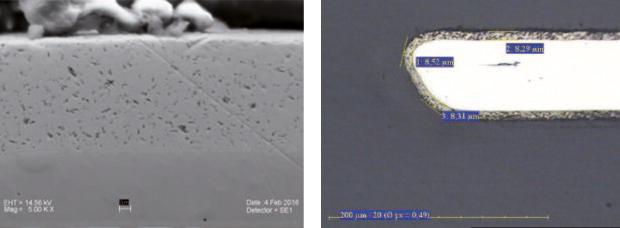
Cross-section through the electrolytic nickel dispersion layer DIAGLIDE with embedded nanoparticles (left) and a chemical nickel-phosphorus layer with embedded silicon carbide (SiC) and very good, contour-accurate layer distribution (right).
01
Design of the Contact Surfaces
Wear caused by the friction of surfaces against each other is strongly influenced by the type and size of the actual (microscopic) contact areas. The roughness of the contact surfaces, as well as the orientation of machining structures such as turning or grinding marks, play a role here. The smoother a surface is, the larger the actual contact areas and the lower the actual surface pressure at the contact areas. The degree of wear tends to increase as the surface roughness of one or both friction partners increases.
02
Hardness of the Contact Surfaces
A higher surface hardness improves resistance to shearing or chipping of material from the component surfaces of the friction partners. The risk of shearing or chipping is lower when the surfaces of the friction partners consist of the same material.
03
Mechanical Properties of the Substrate
Layers with high hardness, such as chromium, require a base material with sufficiently high strength to prevent cracking or breaking of the layer; alloy steels, for example, offer good suitability.
04
Coverage of the Contact Surfaces with Foreign Substances
The friction properties of two tribological surfaces are altered by the presence of foreign substances (oil, grease, dirt). Oil and grease generally have a positive effect on friction properties, while contamination has a negative effect. However, oils and greases, as well as any degradation products that may form, can worsen corrosion resistance. When using dispersion layers, it must be checked to what extent foreign substances impair the effectiveness of the embedded particles.
05
Design
Chemical nickel layers (primarily nickel) are characterized by high contour accuracy and require no mechanical post-processing to achieve surfaces with high fit precision. With electrolytic coatings, edge build-up must be expected, which becomes more pronounced as layer thickness increases. In individual cases, the options for mechanical post-processing prior to applying a coating should be reviewed.
Characteristics
For DIAGLIDE Coatings
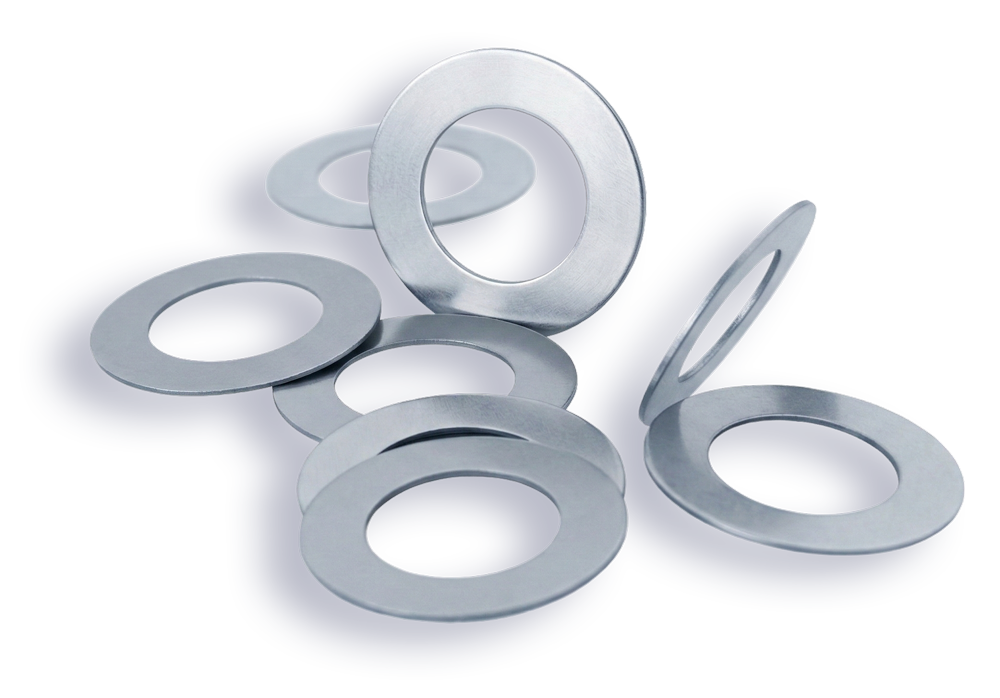
Metallic workpieces gain improved properties with regard to wear and corrosion through the application of DIAGLIDE® coatings. Depending on the application, different variants from the group of composite and dispersion layers are available.
Variants Through Chemical Deposition
- Nickel + nickel-phosphorus dispersion
- Nickel-phosphorus + nickel-phosphorus dispersion
- Nickel + chromium
- Nickel-phosphorus + chromium
Variants Through Electrolytic Deposition
- Nickel + nickel dispersion
- Nickel + chromium (chromium electrolytic)
- Nickel + nickel-phosphorus dispersion
- Nickel-phosphorus + nickel-phosphorus dispersion
The nickel-phosphorus alloy variant can be deposited both chemically/electrolessly ( > high contour accuracy, > low deposition rate) and electrolytically ( > low contour accuracy, > high deposition rate).
Due to its low deposition rate, chemically deposited nickel is preferably used for layer thicknesses below 30 μm (0.03 mm). Electrolytically deposited nickel is suitable for layers up to several millimeters thick. The following variants are available for nickel-based dispersion layers:
How It Works
How DIAGLIDE Works
Schematic representation of a wear-resistant DIAGLIDE system consisting of the dispersion layer and the counterpart of the friction pairing
Contact
Your Inquiry
Do you have questions about our product systems or fields of application? We would be happy to advise you comprehensively via our contact form.