

DIAGLIDE
Thrust Shims
With Friction Reduction for Sliding Surfaces for Optimal Synchronization
- Expert consultation
- Fast production
- High-performance quality
- Fair pricing
- Long-lasting functional durability
Thrust Shims
Friction-Reducing Washers
DIAGLIDE THRUST SHIMS & WASHERS offer an extremely wide range of thrust washers, shim washers, and spacer washers.
DIAGLIDE THRUST SHIMS are used as bearing surfaces for all types of rotating applications, where a cost-effective component takes on the function of a plain bearing surface in lubricated and unlubricated applications. Axial movements along a shaft can thus be set to exact tolerances.
DIAGLIDE THRUST WASHERS are spacer washers and shim washers used to precisely adjust axial spacing and length tolerances in axle and drive shafts, as well as any tightly toleranced length dimension.
The Key Advantages of Using THRUST SHIMS & WASHERS with DIAGLIDE Coating:
- The all-rounder for tribological systems
- Reduces friction and wear
- High lubricant film affinity
- Optimal sliding behavior
- Wear-resistant friction pairing
- Long-lasting corrosion protection
- Adjustable hardness (400–1,100 HV)
- Increase in safety factor
- Cost reduction
- Easy handling
- Adjustable friction values
- Exact dimensional tolerances
- Available as individual parts and in series
- Short delivery times
- Highly flexible manufacturing
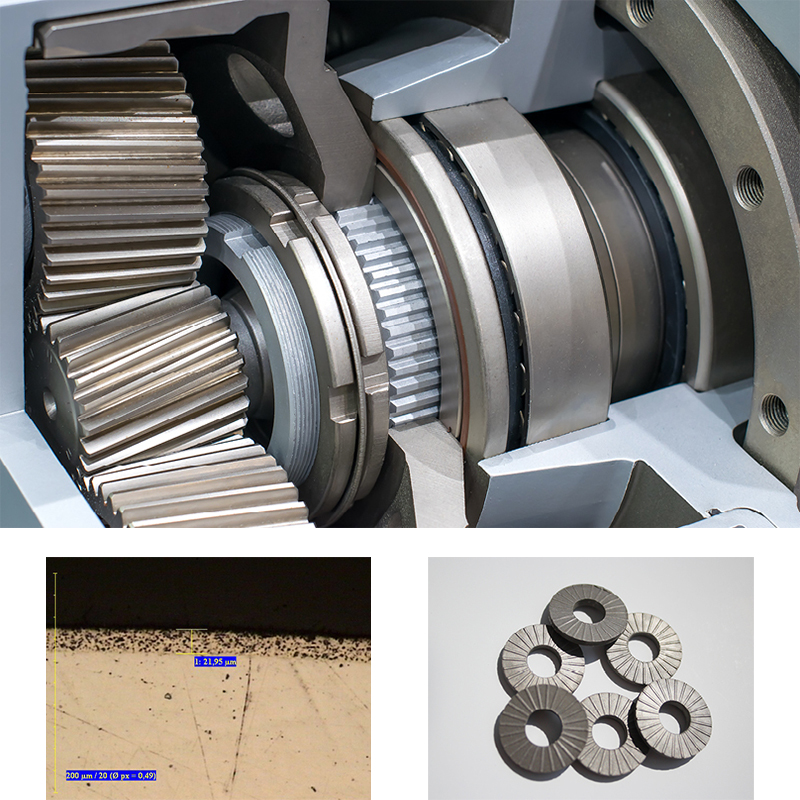
Friction Reduction
Flexible Manufacturing
The shim and spacer washers can be precisely ground to within a few μ (< 5 μ). Typical applications include axle assemblies, transmission (shafts), pump impellers and shafts, and motors. Different thicknesses can be produced from the same types and then used in sets to define clearance and length compensation functions.
Frequent use is also found in the synchronization of two assemblies or machine bodies. The substrates are available in various steel and light metal materials, or, for example, in copper and nickel. Special materials are available on request. Antimagnetic, conductive, or insulating functions can also be produced.
Thanks to flexible manufacturing, individual and series parts can be produced with short delivery times.
Schematic representation of the friction-increasing system consisting of the dispersion layer and the counterpart of the friction pairing
Application Areas
Thrust Shims in Use

Textile Machinery and Spinning
DIAGLIDE coatings for wear parts

Automotive Industry and Engine Technology
DIAGLIDE THRUST WASHER AND SHIMS for sliding, friction-reducing applications in transmission and axle systems

Tool and Mold Making
DIAGLIDE coatings for tools and casting molds

Motorsport and Racing
DIAGLIDE coatings for components of injection systems

Conveyor Technology and Pumps
DIAGLIDE THRUST SHIMS as thrust washers

Aerospace
DIAGLIDE coatings for aluminum, magnesium, and titanium components
Application
How DIAGRIP Thrust Shims Are Used
In numerous applications, it is necessary to move metallic components against one another without them being subject to noticeable wear during use. Depending on the field of application, such component or material contact can occur with or without additional lubricant.
Typical examples of components include rotors and plungers for oil extraction, drive components for internal combustion engines, transmissions or compressors, hydraulic cylinders or hydraulic components, pumps, pressure cylinders, or components in textile machinery. In most cases, the requirements go beyond high wear resistance combined with low friction, as high corrosion resistance of the surface is also particularly needed. In addition, applied DIAGLIDE® coating systems must exhibit exceptionally good adhesion to the base material and, in the case of cost-intensive components, allow for the repair of damaged or worn surfaces.
Among the widely used wear-resistant coatings are, above all, those based on chromium and nickel or nickel alloys, which are used for DIAGLIDE® coatings. Both materials have a high to very high base hardness. Hard materials withstand mechanical stresses under applied pressure and/or friction. This prevents chipping and breakage of coating fragments.
If, on the other hand, such chipping and breakage occur and get caught between moving components, they act as abrasive particles and intensify surface damage through wear.
Another way to reduce wear is the incorporation of friction-reducing solid lubricants – so-called dispersion layers. Proven solid lubricants include, for example, PTFE (polytetrafluoroethylene – Teflon), hexagonal boron nitride, as well as graphite and MoS2. As a matrix material for embedding solid lubricants, electrolytically and chemically deposited nickel as well as nickel-phosphorus alloys offer ideal conditions for producing surfaces with different properties tailored to the respective application. The hardness of the layers can be adjusted within a range of approximately 450 HV to approximately 1,100 HV. The corrosion resistance of the layers varies depending on the phosphorus content selected.
Characteristics
For Wear / Corrosion Protection with DIAGLIDE Coatings
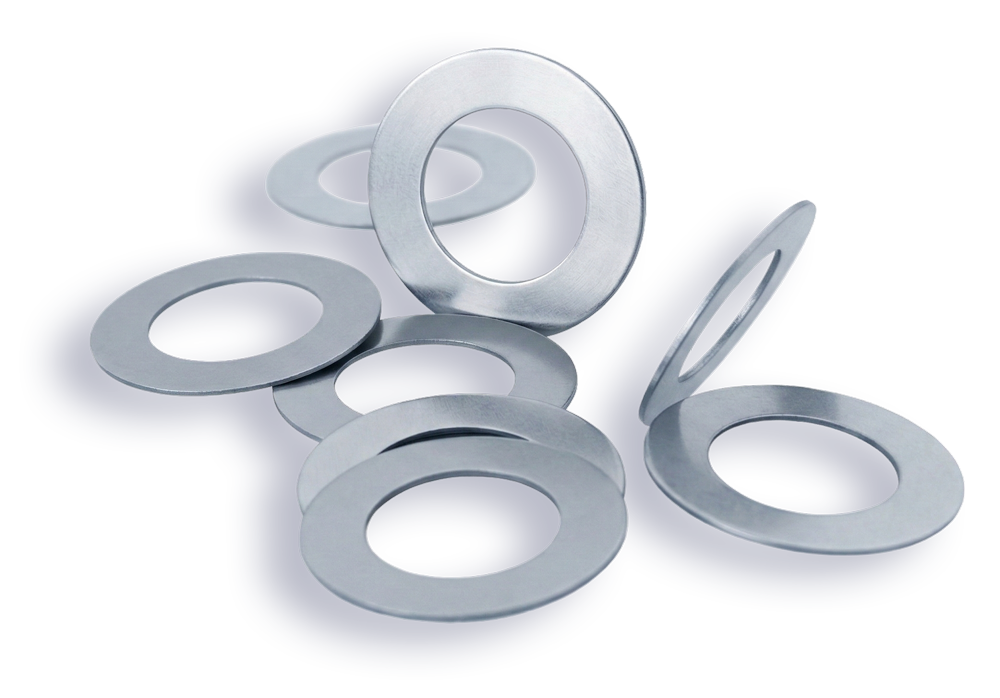
Metallic workpieces gain improved properties with regard to wear and corrosion through the application of DIAGLIDE® coatings. Depending on the application, different variants from the group of composite and dispersion layers are available.
Variants Through Chemical Deposition
- Nickel + nickel-phosphorus dispersion
- Nickel-phosphorus + nickel-phosphorus dispersion
- Nickel + chromium
- Nickel-phosphorus + chromium
Variants Through Electrolytic Deposition
- Nickel + nickel dispersion
- Nickel + chromium (chromium electrolytic)
- Nickel + nickel-phosphorus dispersion
- Nickel-phosphorus + nickel-phosphorus dispersion
The nickel-phosphorus alloy variant can be deposited both chemically/electrolessly ( > high contour accuracy, > low deposition rate) and electrolytically ( > low contour accuracy, > high deposition rate).
Due to its low deposition rate, chemically deposited nickel is preferably used for layer thicknesses below 30 μm (0.03 mm). Electrolytically deposited nickel is suitable for layers up to several millimeters thick. The following variants are available for nickel-based dispersion layers:
Contact
Your Inquiry
Do you have questions about our product systems or fields of application? We would be happy to advise you comprehensively via our contact form.